
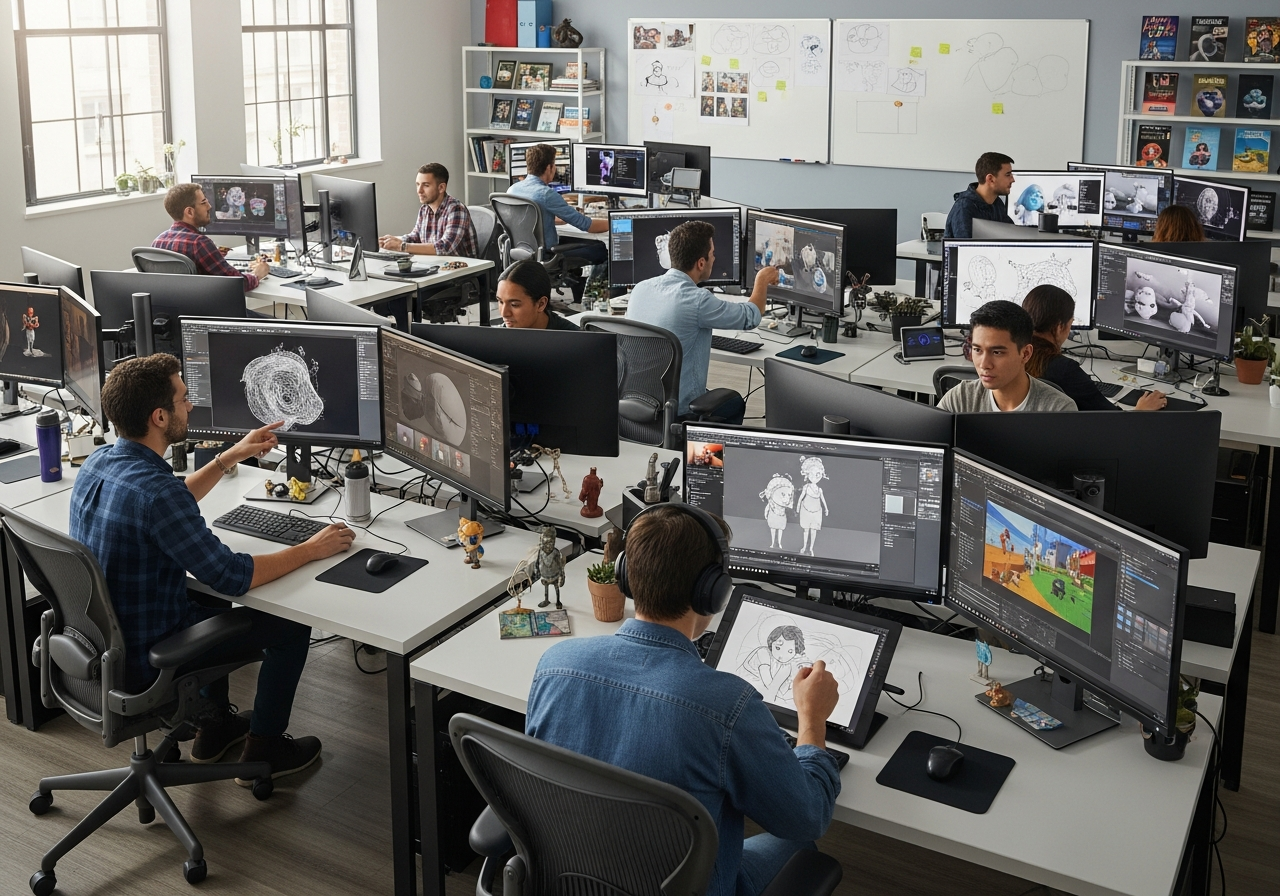
When Marvel Studios collaborated with Canadian VFX houses on recent blockbuster productions, teams in Montreal seamlessly shared USD-formatted assets with partners in London and Los Angeles, enabling real-time collaboration across three continents. This global workflow exemplifies how modern animation and VFX pipelines have evolved beyond geographical boundaries, yet each region has developed distinct approaches to managing complex creative projects.
The fundamental differences between Canadian, US, and European studio workflows reflect their unique market positions and technological priorities. Canadian studios have embraced hybrid cloud architectures and USD collaboration frameworks, positioning themselves as ideal partners for international projects. American studios typically rely on tool-heavy, proprietary systems optimized for high-volume production, while European facilities showcase diverse software ecosystems that vary significantly by country and specialization area.
Core Elements of Studio Pipelines
Modern studio pipelines encompass the entire lifecycle of digital content creation, from initial asset development through final rendering and delivery. These comprehensive workflows manage asset creation, texturing, rigging, animation, lighting, and assembly phases while ensuring version control and quality consistency across distributed teams. The complexity of contemporary productions demands sophisticated data management systems that can handle terabytes of content while maintaining creative flexibility.
Universal Scene Description (USD) has emerged as a transformative universal format enabling seamless cross-region collaboration in ways previously impossible. Originally developed by Pixar, USD provides a standardized framework for describing, composing, simulating, and collaborating on 3D scenes across different software packages and geographic locations. This standardization allows Canadian studios to excel as international collaboration hubs, working efficiently with partners worldwide regardless of their primary software tools.
The integration of USD into studio pipelines represents a paradigm shift from isolated, proprietary workflows to open, collaborative ecosystems. Studios can now focus on creative excellence rather than technical compatibility challenges, enabling more ambitious projects that leverage global talent pools effectively.
Asset Management Across Regions
Regional approaches to asset management reveal distinct philosophical differences in how studios organize and distribute digital content. Canadian facilities have pioneered cloud-first strategies that complement their role as international collaboration partners, while maintaining strict security protocols for high-profile projects.
The key characteristics of regional asset management include:
- Canada: Cloud-native storage with USD-centric workflows enabling real-time global collaboration and automated version synchronization across time zones
- United States: Proprietary asset databases optimized for high-volume production with emphasis on render farm integration and legacy system compatibility
- Europe: Diverse software ecosystems requiring flexible asset formats, with regional hubs specializing in specific production stages or visual styles
- Hybrid Systems: Emerging approaches combining cloud accessibility with local processing power to balance collaboration needs with performance requirements
- Security Protocols: Region-specific data protection standards influencing asset storage locations and access control mechanisms
- Bandwidth Optimization: Intelligent sync systems that prioritize critical assets based on production schedules and team dependencies
Software Tool Integration
The choice and integration of primary software tools reflects each region’s production priorities and collaborative requirements. Canadian studios have gravitated toward Maya and Blender combinations that work seamlessly with USD workflows, facilitating smooth handoffs between international partners. American facilities often maintain Maya-centric pipelines with deep customization, while European studios embrace Cinema 4D and Blender for their flexibility and cost-effectiveness.
Interoperability challenges vary significantly by region, with Canadian studios investing heavily in USD translation layers that enable effortless collaboration regardless of partners’ primary tools. This strategic focus on tool-agnostic workflows has positioned Canadian facilities as preferred partners for complex international productions.
| Region | Primary Tools | Interoperability |
|---|---|---|
| Canada | Maya, Blender, Houdini with USD integration | Excellent – USD-native workflows |
| United States | Maya-centric with proprietary extensions | Limited – custom pipeline dependencies |
| United Kingdom | Maya, Nuke, proprietary compositing tools | Moderate – industry standard formats |
| France | Cinema 4D, Blender, local software solutions | Variable – depends on project requirements |
| Eastern Europe | Blender-heavy with cost-effective alternatives | Good – open source compatibility |
Canadian Pipeline Advantages
Canadian studios have strategically positioned themselves at the forefront of global collaboration through their early adoption of USD workflows and cloud-native architectures. This approach contrasts sharply with traditional US studio models that often operate in relative isolation, relying on proprietary systems that can create collaboration bottlenecks.
The primary advantages of Canadian pipeline approaches include:
- Global Team Integration: Seamless collaboration with international partners through USD and Omniverse platforms, eliminating traditional file format barriers
- Cloud Storage Optimization: Strategic use of Canadian cloud regions offering both performance and environmental benefits for distributed teams
- Time Zone Efficiency: Pipeline designs that maximize productivity across global time zones, enabling true 24-hour production cycles
- Scalable Infrastructure: Hybrid cloud architectures that scale resources dynamically based on project demands without long-term infrastructure commitments
- Cross-Platform Compatibility: Investment in tool-agnostic workflows that work equally well with Maya, Blender, and emerging software solutions
- Regulatory Compliance: Built-in adherence to international data protection standards facilitating work with global entertainment companies
- Cost-Effective Collaboration: Reduced overhead for international projects through optimized data transfer and automated synchronization systems
USD Implementation in Canada
Canadian studios have embraced Pixar’s Universal Scene Description as more than just a file format—treating it as a foundational architecture for international collaboration. Major Canadian VFX houses like Industrial Light & Magic Vancouver and Framestore Montreal have integrated USD deeply into their pipelines, enabling seamless handoffs with partners in London, Singapore, and Los Angeles without the traditional friction of format conversions.
The practical implementation of USD in Canadian workflows extends beyond simple asset exchange to encompass real-time collaborative editing sessions where artists in different countries can work simultaneously on the same virtual sets. This capability has proven particularly valuable for large-scale productions requiring tight deadlines and consistent visual quality across multiple facilities. Canadian studios often serve as the technical backbone for these collaborations, providing the USD expertise and infrastructure that enables global teams to work as seamlessly as if they were in the same building.
Recent multi-continent projects involving Canadian studios demonstrate USD’s transformative impact on production efficiency. Complex scenes that previously required days of file preparation and conversion now flow seamlessly between facilities, with Canadian teams often providing the USD conversion and optimization services that enable smooth collaboration between partners using different primary software tools.
US Workflow Characteristics
American studios have traditionally focused on large-scale, high-volume production capabilities optimized for major studio releases and franchise content. Their workflows emphasize proprietary pipeline development that maximizes control and consistency but can create challenges for external collaboration. This approach reflects the historical dominance of US entertainment companies and their preference for maintaining tight control over production processes.
The scale-focused nature of US workflows often requires extensive customization of standard software packages, creating powerful but inflexible systems. While these pipelines excel at handling massive asset libraries and complex rendering requirements, they can struggle with the rapid format changes and collaborative flexibility that characterize modern international productions.
| Stage | US Focus | Challenges |
|---|---|---|
| Pre-Production | Extensive previz and proprietary asset development | Limited external collaboration capabilities |
| Asset Creation | High-detail modeling with custom pipeline integration | Format conversion bottlenecks for external partners |
| Animation | Volume production with standardized workflows | Inflexibility for creative changes late in production |
| Lighting | Proprietary rendering solutions optimized for scale | Difficulty integrating external lighting work |
| Compositing | Highly automated with custom tools and scripts | Limited compatibility with non-standard deliverables |
| Final Delivery | Streamlined for theatrical and streaming platforms | Multiple format requirements increase complexity |
Scale and Standardization
Paradoxically, while Pixar originated USD technology, many US studios have been slower to adopt it for global collaboration compared to their Canadian counterparts. This hesitation often stems from significant investments in existing proprietary systems and concerns about maintaining competitive advantages through unique pipeline capabilities. Major US facilities like Disney Animation Studios and DreamWorks have developed sophisticated internal tools that work exceptionally well within their organizations but can create barriers when collaborating with external partners.
The emphasis on standardization within US studios reflects their focus on consistent, repeatable processes for large-scale productions. However, this internal standardization can paradoxically create external compatibility challenges, as highly optimized proprietary formats may not translate easily to industry-standard formats required for collaboration.
Production Volume Management
US studios excel at managing the enormous asset volumes required for major animated features and VFX-heavy blockbusters. Their pipelines are engineered to handle hundreds of characters, thousands of environments, and millions of individual assets while maintaining consistency and quality. This capability represents a significant competitive advantage for large-scale productions but can create overhead for smaller or more experimental projects.
The focus on volume management has led to sophisticated automation systems that minimize manual intervention in routine pipeline tasks. While this approach maximizes efficiency for standardized workflows, it can create rigidity that makes it difficult to accommodate the creative flexibility often required for international collaborations with diverse working styles and technical approaches.
European Studio Approaches
European animation and VFX studios operate within a remarkably diverse ecosystem that reflects the continent’s varied cultural and economic landscape. Unlike the more unified approaches seen in Canada or the US, European facilities often specialize in specific niches, from French animation studios focusing on stylized 2D-3D hybrid techniques to Eastern European facilities excelling in cost-effective 3D production and UK studios leading in high-end VFX for film and television.
This diversity extends to software choices, with European studios often embracing a mix of industry-standard tools and regional solutions. French studios frequently utilize Cinema 4D for its motion graphics capabilities, while Scandinavian facilities have pioneered innovative uses of Blender for feature animation. The result is a less unified but highly creative approach to pipeline development that prioritizes flexibility and artistic expression over standardization.
The regional specialization within Europe has created interesting collaboration patterns, with studios often forming temporary partnerships that combine different technical strengths for specific projects. This approach contrasts with the more permanent facility relationships common in North America, creating a dynamic but sometimes unpredictable production environment that requires flexible pipeline architectures.
Regional Variations in Europe
The technical approaches across European regions reflect distinct market conditions, educational traditions, and creative priorities. UK studios often serve as bridges between American and European approaches, combining high-end technical capabilities with flexible collaboration practices. French facilities emphasize artistic innovation and have pioneered unique stylistic approaches that require specialized pipeline solutions.
Eastern European studios have emerged as cost-effective production partners, often specializing in specific pipeline stages like modeling or animation while maintaining high quality standards. This specialization has created a network of interconnected facilities that can handle complex projects through distributed collaboration, though coordination can be more challenging than working with single large facilities.
Regional rankings in European VFX and animation production include:
- United Kingdom: Leading in high-end VFX with studios like Framestore and Double Negative setting global standards for film and television effects
- France: Dominating stylized animation and motion graphics with innovative techniques that blend 2D and 3D approaches
- Germany: Excelling in automotive and architectural visualization with precise, technically-focused pipelines
- Eastern Europe: Providing cost-effective production services with increasingly sophisticated technical capabilities and specialized expertise
- Scandinavia: Pioneering sustainable production practices and innovative uses of open-source tools for both creative and environmental benefits
Key Comparison: Tools and Collaboration
The fundamental differences between regional approaches become most apparent when examining direct comparisons across Canada, the US, and Europe. Canadian studios have positioned themselves as collaboration facilitators, investing heavily in USD workflows and cloud infrastructure that enables seamless international partnerships. American facilities prioritize internal optimization and proprietary solutions that maximize efficiency within their organizations but can create barriers for external collaboration.
European approaches vary significantly by region but generally emphasize flexibility and creative adaptation over standardization. This diversity creates opportunities for innovative solutions but can also complicate large-scale collaborative projects that require consistent technical approaches across multiple facilities.
| Aspect | Canada | US | Europe |
|---|---|---|---|
| Primary Focus | Global collaboration and USD integration | High-volume proprietary production | Diverse specialization and creative flexibility |
| Cloud Strategy | Cloud-native with global accessibility | Hybrid with security-focused local storage | Mixed approaches varying by facility size |
| Collaboration Tools | Omniverse, USD-native workflows | Proprietary systems with limited external access | Varied solutions based on project requirements |
| Software Flexibility | High – tool agnostic approaches | Low – optimized for specific toolchains | Variable – depends on studio specialization |
| Cost Structure | Competitive with collaboration premium | High-end with volume discounts | Wide range from budget to premium options |
Collaboration Hubs
NVIDIA Omniverse has emerged as a particular strength for Canadian studios, providing real-time collaborative capabilities that align perfectly with their role as international production partners. Major Canadian facilities have invested heavily in Omniverse infrastructure, enabling multiple artists from different countries to work simultaneously on the same scenes with immediate visual feedback and automatic synchronization.
This technological advantage has positioned Canadian studios as preferred partners for complex international productions requiring tight coordination between multiple facilities. The ability to provide real-time collaborative editing sessions where directors in Los Angeles can review work being done simultaneously by teams in Montreal, London, and Mumbai represents a significant competitive advantage that traditional file-based workflows cannot match.
The success of Omniverse-based workflows in Canadian studios has begun influencing pipeline development worldwide, with US and European facilities increasingly recognizing the need for real-time collaborative capabilities to remain competitive in the global market. However, implementation requires significant infrastructure investment and cultural changes that can be challenging for studios with established proprietary workflows.
Cloud and Location Factors
Geographic location plays a crucial role in cloud infrastructure decisions, with Canadian studios benefiting from access to environmentally friendly cloud regions powered by hydroelectric energy. This advantage has become increasingly important as major entertainment companies prioritize sustainability in their production choices.
| Region | Cloud Regions | Low CO2 Options |
|---|---|---|
| Canada | Montreal, Toronto with Google Cloud integration | Excellent – hydroelectric power sources |
| United States | Multiple AWS and Azure regions nationwide | Variable – depends on specific location |
| Europe | London, Frankfurt, Amsterdam hubs | Good – increasing renewable energy adoption |
Future Trends and Challenges
The future of studio pipelines appears to be converging toward USD standardization as a bridge between regional differences, with Canadian studios leading this hybrid transformation. The success of USD-based international collaborations has demonstrated clear advantages in terms of efficiency, quality consistency, and creative flexibility that are becoming difficult for traditional proprietary approaches to match.
However, the transition to standardized collaborative workflows faces significant challenges, particularly for established studios with substantial investments in existing proprietary systems. The technical migration challenges are compounded by cultural resistance within organizations that have built competitive advantages around unique pipeline capabilities and may be reluctant to adopt more open approaches that could reduce differentiation.
Regulatory and energy considerations play an increasingly important role in pipeline decisions, with environmental sustainability becoming a competitive factor as major entertainment companies commit to carbon neutrality goals. Canadian studios’ access to clean energy sources provides a strategic advantage that may become more significant as production volumes continue to increase globally.
The emergence of real-time collaborative technologies like Omniverse suggests that future pipelines will prioritize immediate feedback and simultaneous editing capabilities over traditional file-based workflows. This shift favors regions and studios that have invested in advanced networking infrastructure and collaborative technologies, potentially reshaping the competitive landscape of global animation and VFX production.
Artificial intelligence integration represents another significant trend that could either enhance regional collaboration or create new forms of competitive differentiation. Studios that successfully integrate AI tools while maintaining human creative control may gain significant advantages in both quality and efficiency, though the implementation approaches are likely to vary significantly between regions based on their existing technical foundations and creative priorities.
Adoption Barriers
The transition to more collaborative, standardized pipeline approaches faces several practical challenges that vary significantly by region and studio size. Successful adoption requires careful planning and phased implementation to minimize disruption to ongoing productions while building new collaborative capabilities.
Key steps for studios adopting USD-like collaborative pipelines include:
- Infrastructure Assessment: Evaluate existing systems and identify integration points where USD workflows can be implemented without disrupting critical production processes
- Pilot Project Implementation: Begin with small-scale international collaborations to test USD workflows and identify potential technical or cultural challenges before full-scale adoption
- Staff Training Programs: Develop comprehensive training initiatives that help artists and technical staff understand both the technical aspects of USD and the collaborative opportunities it enables
- Partner Network Development: Establish relationships with USD-capable studios in different regions to create opportunities for collaborative projects and knowledge sharing
- Technology Platform Selection: Choose appropriate cloud infrastructure and collaboration tools that support USD workflows while meeting security and performance requirements for specific project types
- Workflow Documentation: Create detailed documentation of new collaborative processes to ensure consistency and enable smooth scaling as adoption expands across larger projects and more international partners